


Richelieu And His Age - Assertion Of Power And Cold War
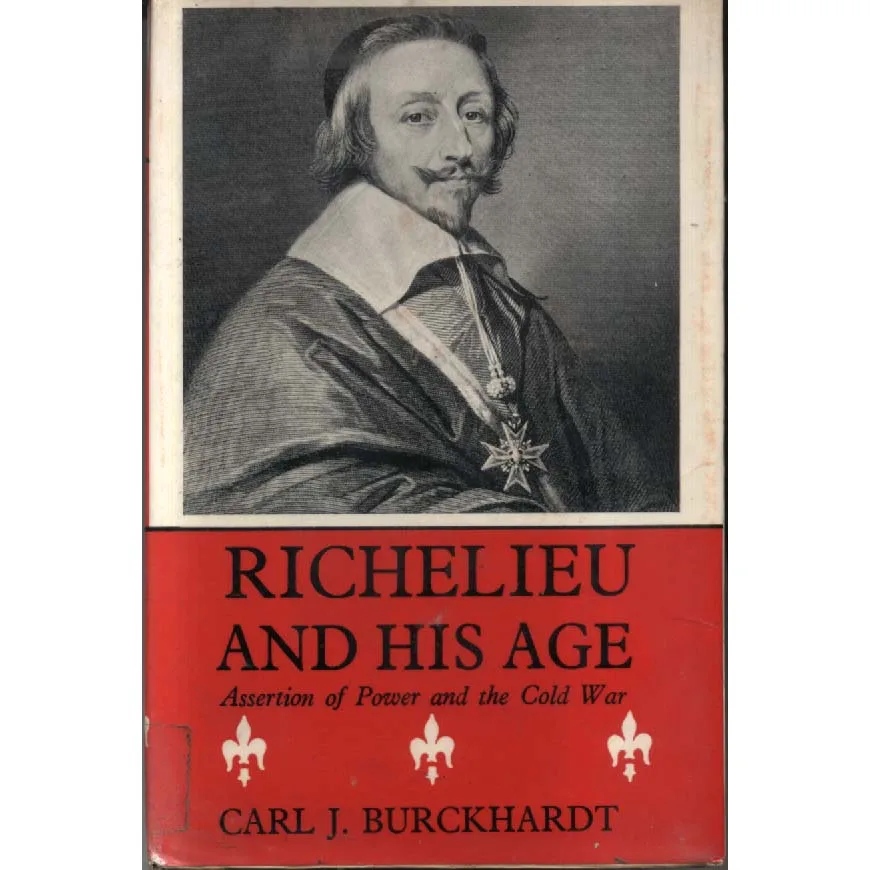
Publisher: George Allen and Unwin
Format: Hardback
ISBN: 0049220241
Richelieu and His Age – Assertion of Power and Cold War (1970) by Carl J. Burckhardt
George Allen & Unwin | ISBN: 0049220241
Condition: Good (as sold by Crappy Old Books). Ex-library book.
There are politicians. There are statesmen. And then there is Cardinal Richelieu — the man who managed to combine ecclesiastical robes with unapologetic realpolitik, red hat with cold calculation, and devotion with diplomacy sharp enough to redraw Europe. Carl J. Burckhardt’s Richelieu and His Age – Assertion of Power and Cold War is your invitation into seventeenth-century power politics, delivered with the grave elegance of a historian who understands that nothing about high office has ever been simple.
The subtitle alone is deliciously modern. “Cold War” in the 1600s? Absolutely. Burckhardt draws the lines between Richelieu’s world and the twentieth century with steady, deliberate strokes. Alliances, proxy struggles, ideological posturing, continental chess played over decades — it turns out Europe was practising strategic brinkmanship long before anyone invented nuclear deterrence. Richelieu did not need missiles; he had diplomacy, intelligence networks, and a deeply held belief that France should not be anyone else’s side project.
This is not a breezy “colourful court anecdotes” biography. It’s a study in statecraft: the consolidation of royal authority, the taming of aristocratic independence, the shaping of foreign policy with a ruthlessness that still feels bracing. Burckhardt presents Richelieu not as a pantomime villain or moustache-twirling schemer, but as something more unsettling — a serious mind operating within brutal constraints, determined to assert France’s position in a Europe permanently on the verge of implosion.
And what a Europe it was: Habsburg ambitions, Protestant–Catholic tensions, dynastic rivalries, and the ever-present risk that a diplomatic misstep might turn into open war. The idea that the early modern period was somehow naïve compared to modern geopolitics quietly evaporates as you read. Richelieu’s world may lack satellites, but it does not lack calculation.
Burckhardt’s prose carries that mid-twentieth-century gravitas — measured, thoughtful, occasionally austere — the kind of historical writing that assumes you are capable of serious attention and rewards you accordingly. It’s a book for readers who like their history with structure and strategy, not just spectacle.
This copy is Good, as sold by Crappy Old Books, and is an ex-library book — meaning it bears the respectable signs of a previous institutional life. Expect stamps, perhaps a discreet label or pocket residue: the quiet badges of a volume once deemed important enough for public lending. Structurally sound, entirely readable, and imbued with that faint aura of scholarly approval that only library copies acquire.
Perfect for:
-
readers who enjoy power politics without modern spin
-
students of diplomacy and statecraft
-
lovers of European history beyond the costume-drama surface
-
anyone who suspects that “cold war” is less an era than a habit
Open it and step into a Europe balanced on strategy and suspicion — where a cardinal in scarlet quietly shaped the fate of nations, and where power, once asserted, rarely goes back into its box.
Keep browsing: See more History books Other books by Carl J Burckhardt
